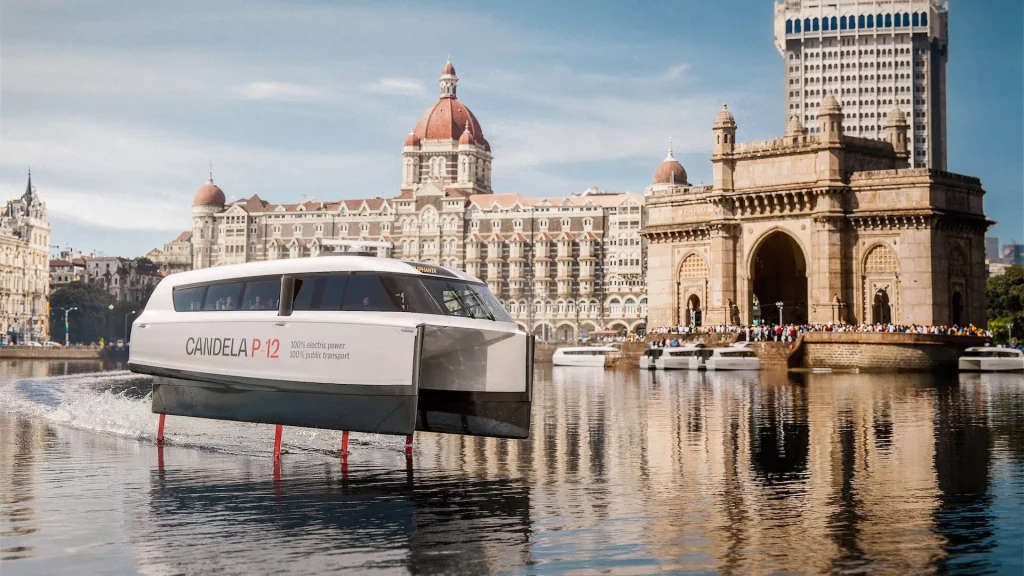

Mumbai is infamous for two things (among others) – high rent and even higher traffic. While we may not have a solution to both, Mumbai-based operator Jal Vimana has an answer to the critical gridlock. Rather than extending roads and railways in an over-saturated transport system, Mumbai is ready to utilise its most underused asset, the sea. For an ever-expanding financial capital with 23 million residents, the city is getting its very first water metro. Mumbai’s commuters will soon be able to fly to work over the sea, on electric ships. To do that, a fleet of 11 hydrofoiling Candela P-12 commuter ferries has landed to link its waterways.
“This is a groundbreaking project that unlocks the full potential of Mumbai’s waterways for efficient commuting. And, by investing in hydrofoil technology, the city is leapfrogging legacy waterborne transport systems,” states Gustav Hasselskog, CEO and Founder of Candela.
Mumbai Water Metro – Candela P12
As the bustling financial capital, Mumbai is one of the fastest-growing cities in the world. The state’s Ports Minister, Nitesh Rane and Chief Minister, Devendra Fadnavis, recently announced that Mumbai’s waterways are set to transform into clean and efficient water metros. The framework for Mumbai Water Metro is directly modelled on and inspired by the Kochi Water Metro in Kerala. The Maharashtra Government hired Kochi Metro Rail Limited (KMRL) to conduct the feasibility studies and prepare the detailed project report for Mumbai. However, Mumbai plans to adapt the blueprint for its rougher seas by upgrading to Swedish hydrofoils. At the helm of this vision is the Swedish marine tech company, Candela.
The novelty of Candela P-12 lies in its hydrofoiling technology. A hydrofoil is essentially an underwater wing attached to the bottom of the boat’s hull. Candela uses computer-guided underwater wings to raise its hulls above water. This flow creates a lift under the boat, and upon reaching a certain speed, the lift becomes strong enough to hoist the hull completely out of the water, making it fly. Additionally, it slashes energy usage by 80%, especially eliminating wake and slamming without disrupting marine life or other coastal infrastructure. It further runs smoothly, silently, safely, and at an affordable price over conventional vessels. It is a gamechanging especially for India’s zero-carbon goal and the future of sustainable transport over long distances.
Key Connections
Mumbai water metro plans to have the iconic Gateway of India serving as its primary hub. Whereas the initial networks by JalVimana target some of the city’s heavily congested corridors.
The initial phase targets the route between the Gateway of India and Alibaug and Elephanta Caves. Additionally, the network plans to extend its services to connect the new airport in Navi Mumbai with Central Mumbai, reducing the 90-minute travel time to 30 minutes. As the network scales, the government plans to further expand the grid to hook key Western coastal suburbs, linking Nariman Point, Worli, Bandra, Juhu, and Versova.
Launch Timeline
The ambitious water metro project is rolling out with a carefully structured plan. As of May 2026, the very first Candela p12 vessel has officially arrived at the Jawaharlal Nehru Port Trust and is undergoing final customs clearances. By June, with the onset of heavy monsoons, the port authorities plan to rigorously test the stability of the vehicles. Following successful trials, the Phase 1 commercial launch is expected around December 2026. It will further scale the ecosystem for public usage, expanding into 21 routes and 20 dedicated stations by 2028 or beyond to boost urban transportation.